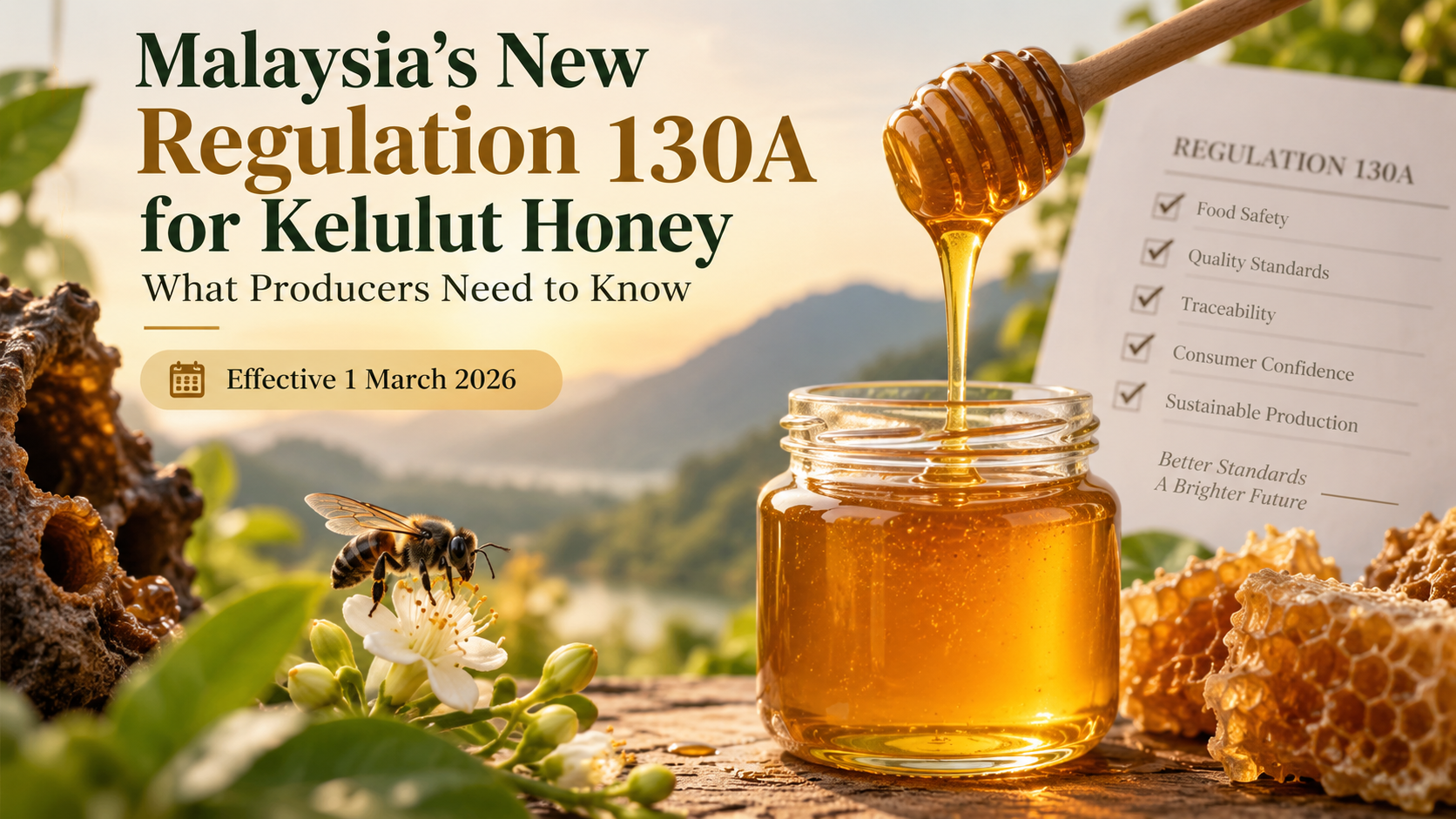
Malaysia’s New Regulation 130A for Kelulut Honey: What Producers Need to Know
Kelulut honey, also known as stingless bee honey or madu kelulut, is now specifically regulated under Malaysia’s Food Regulations 1985 through the introduction of Regulation 130A.
This update is important for kelulut honey producers, retailers, SMEs, brand owners, and product developers because it introduces clearer requirements for product identity, quality, freshness, and microbiological standards.
The Ministry of Health Malaysia, Food Safety and Quality Division lists P.U.(A) 275 Ogos 2025 as the amendment introducing Regulation 130A for madu kelulut and the related amendment to the Fifteenth Schedule. The amendment comes into operation on 1 March 2026
What is Regulation 130A?
Regulation 130A is the new provision under the Food Regulations 1985 that specifically covers kelulut honey or stingless bee honey.
The regulation introduces requirements for kelulut honey, including compositional, physicochemical, quality, and microbiological parameters. These requirements help ensure that products marketed as kelulut honey meet defined expectations for quality and authenticity.
Why Does Regulation 130A Matter?
Kelulut honey has a different composition compared with conventional honey, including its sugar profile, acidity, and moisture characteristics. Because of this, kelulut honey should not be treated exactly the same as ordinary honey.
Regulation 130A helps support:
- Clearer product identity
- Consumer protection
- Quality evaluation
- Regulatory compliance
- More consistent market standards
- Stronger confidence in local kelulut honey products
For producers and retailers, this means product labels, specifications, and laboratory results should be reviewed and updated according to the applicable requirements.
Key Testing Requirements for Kelulut Honey
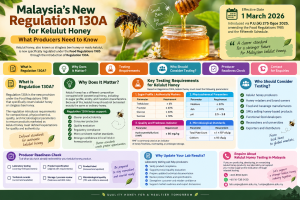
Based on the regulatory update for kelulut honey, the key testing parameters include sugar profile, physicochemical quality, freshness indicator, and microbiological standards.
- Sugar Profile / Authenticity Markers
- Trehalulose: ≥ 6%
- Fructose: ≤ 40%
- Glucose: ≤ 40%
- Sucrose: ≤ 10%
- Physicochemical Parameters
- Moisture: ≤ 22%
- Ash: ≤ 1.0%
- pH: 2.5 – 3.8
- Quality and Freshness Indicator
- Hydroxymethylfurfural, HMF: ≤ 80 mg/kg
HMF is commonly used as an indicator of honey freshness, overheating, or prolonged storage.
- Microbiological Standards
- Total Plate Count: ≤ 1 × 10³ cfu/g
- Coliform: ≤ 10 cfu/g
These parameters help support the evaluation of kelulut honey quality, authenticity, freshness, and microbiological condition.
Why Producers Should Update Their Lab Results
With Regulation 130A coming into effect, kelulut honey producers and retailers should ensure that their product testing records are aligned with the updated requirements.
laboratory testing can help producers:
- Verify product compliance
- Support product quality evaluation
- Prepare updated technical documentation
- Review product labels and specifications
- Strengthen customer and retailer confidence
- Support market readiness and export discussions
Who Should Consider Kelulut Honey Testing?
Kelulut honey testing is useful for:
- Kelulut honey producers
- Honey retailers and brand owners
- Food and beverage manufacturers
- SMEs selling honey-based products
- Functional food developers
- Researchers and universities
- Exporters and distributors
Enquire About Kelulut Honey Testing in Malaysia
If you are producing, developing, or researching kelulut honey products, UNIPEQ can support your honey sugar profile evaluation through relevant laboratory testing.
UNIPEQ Sdn. Bhd.
Tel: +603-8920 8263
WhatsApp: +60 16-738 5430
Email: lab.unipeq@ukm.edu.my / unipeq@ukm.edu.my