Hedonic Test vs QDA: Which Sensory Test is Right for Your Product?
Food sensory analysis can support product development, reformulation, product comparison, and market readiness. However, not all sensory tests answer the same question.
Two common sensory evaluation approaches are Hedonic Testing and Quantitative Descriptive Analysis (QDA). Both are useful, but they serve different purposes.
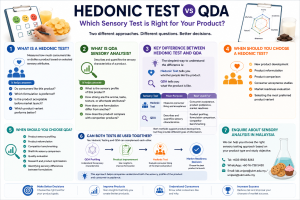
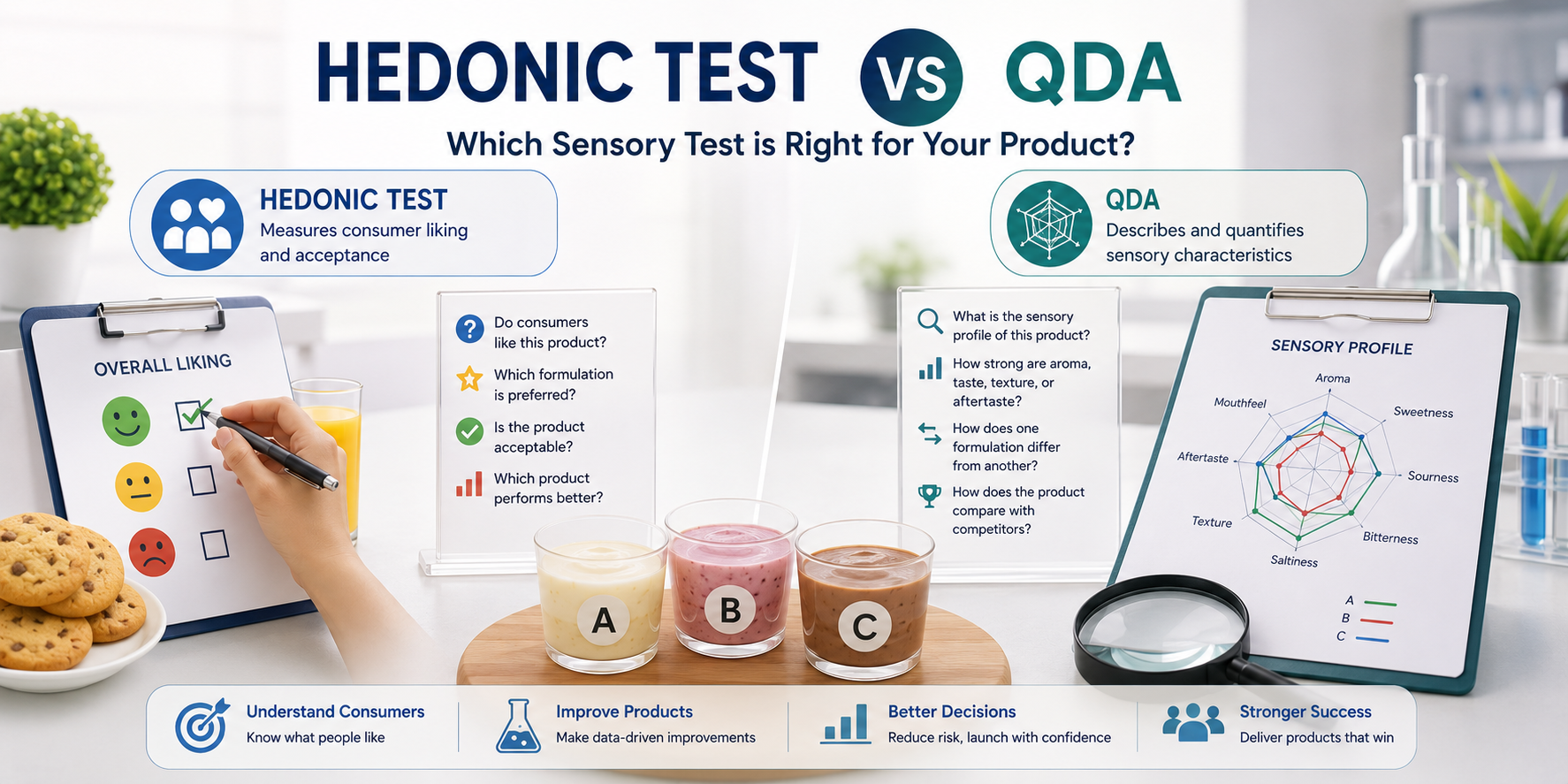
A Hedonic Test focuses on consumer liking and acceptance, while QDA focuses on describing and quantifying product sensory characteristics
What is a Hedonic Test?
A Hedonic Test is used to measure how much consumers like or dislike a food or beverage product based on selected sensory attributes.
It is commonly used to evaluate consumer acceptance before product launch, compare product variants, and identify the most preferred formulation.
A Hedonic Test helps answer questions such as:
- Do consumers like this product?
- Which formulation is preferred?
- Is the product acceptable before market launch?
- Which product variant performs better?
What is QDA Sensory Analysis?
Quantitative Descriptive Analysis (QDA) is used to describe and quantify the sensory characteristics of a food or beverage product.
Instead of focusing mainly on liking, QDA helps identify what the product is like and how it differs from other products or formulations.
QDA helps answer questions such as:
- What is the sensory profile of this product?
- How strong are the aroma, taste, texture, or aftertaste attributes?
- How does one formulation differ from another?
- How does the product compare with competitor products?
Key Difference Between Hedonic Test and QDA
The simplest way to understand the difference is:
- Hedonic Test tells you whether people like the product.
- QDA tells you what the product is like.
|
Sensory Test |
Main Purpose | Best Used For |
|
Hedonic Test |
Measures consumer liking and acceptance | Consumer acceptance, product preference, market readiness |
|
QDA |
Describes and quantifies sensory characteristics | Product profiling, formulation comparison, competitor benchmarking |
Both methods support product development, but they provide different types of information.
When Should You Choose a Hedonic Test?
Choose a Hedonic Test when the main objective is to understand consumer preference or acceptance.
It is suitable for:
- New product development
- Product reformulation
- Product comparison
- Consumer acceptance studies
- Market readiness evaluation
- Selecting the most preferred product variant
When Should You Choose QDA?
Choose QDA when the objective is to understand the detailed sensory profile of a product.
It is suitable for:
- Product sensory profiling
- Product reformulation
- Competitor benchmarking
- Shelf-life sensory comparison
- Quality evaluation
- Research and product optimisation
- Identifying sensory differences between formulations
Can Both Tests Be Used Together?
Yes. In many product development projects, Hedonic Testing and QDA can complement each other.
For example, QDA can help identify the sensory characteristics of different formulations, while a Hedonic Test can show which formulation is preferred by consumers.
A useful product development flow may be:
QDA Profiling → Product Improvement → Hedonic Test → Market Readiness Decision
This approach helps companies understand both the sensory profile of the product and consumer acceptance.
Enquire About Sensory Analysis in Malaysia
If you are developing a food or beverage product and are unsure whether to choose Hedonic Testing, QDA, or both, UNIPEQ can help recommend a suitable sensory analysis approach based on your product type and study objective.